Article: What to Wear to a Pakistani Wedding?
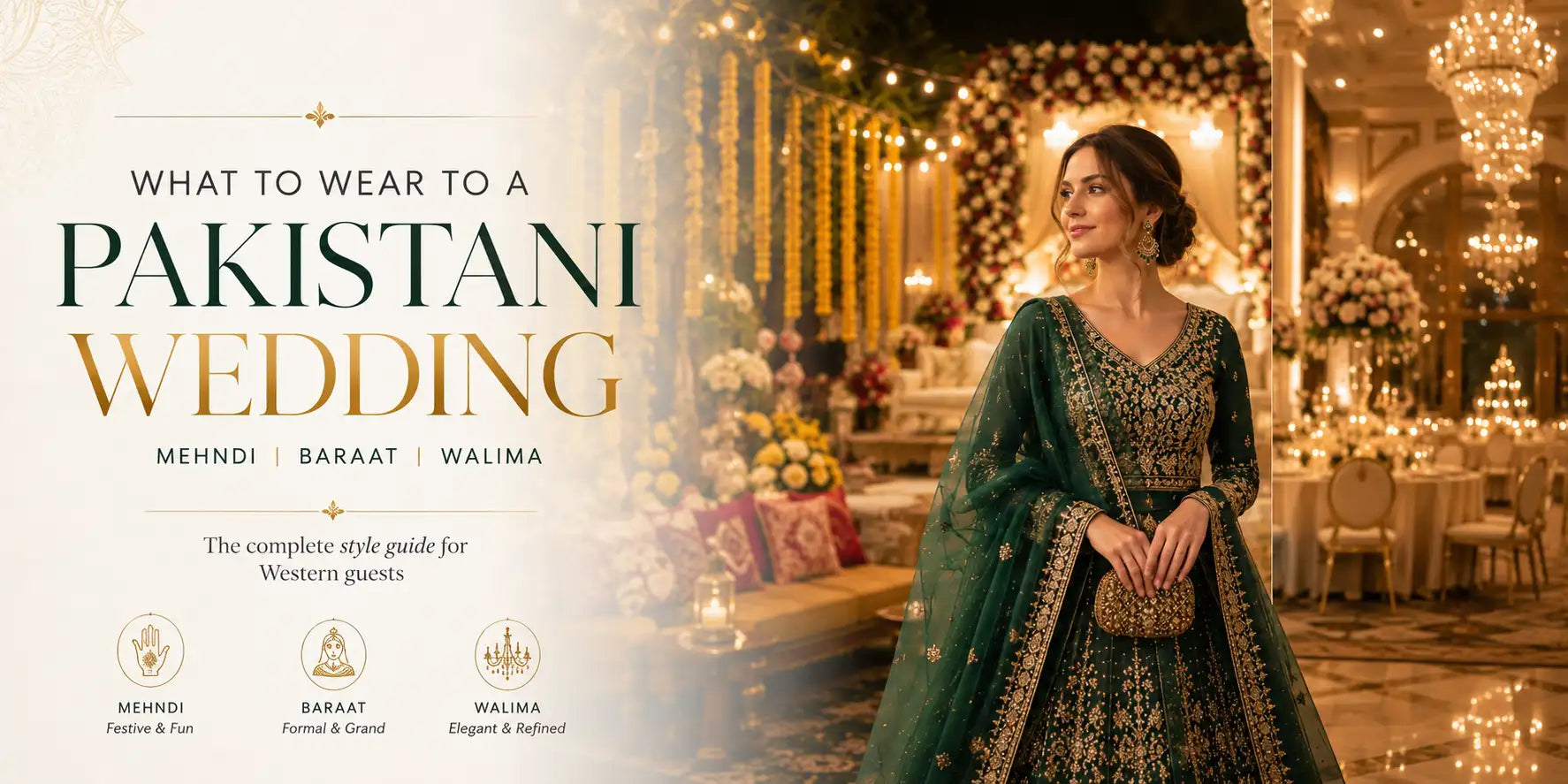
What to Wear to a Pakistani Wedding?
Introduction
You open the wedding invitation and your eye skips past the gold lettering to the three event dates. Mehndi. Baraat. Walima.
The word “formal” is printed next to each one, but you already suspect that a British cocktail dress or an American black-tie gown won’t map neatly onto any of them. That flash of panic is entirely normal, and it’s exactly why this guide exists.
Pakistani wedding attire for a Western guest is not a costume problem. It’s adress-code translation puzzle you can solve, and the solution is far more straightforward than the multi-day itinerary suggests.
- Mehndi = festive cocktail, Baraat = formal gala, Walima = elegant reception: each demands a distinct silhouette and color palette.
- Never wear red or maroon to the Baraat; emerald, sapphire, or gold are your power colors.
- Dupatta draping is non-negotiable: pin it securely for Baraat processions, drape loosely for Walima photos.
- A single versatile lehenga in a neutral jewel tone can be restyled across all three events with strategic accessory swaps.
What you need is a practical wardrobe blueprint that treats each ceremony as its own Western dress-code equivalent.
The Mehndi is a festive cocktail affair: color, movement, and a relaxed silhouette.
The Baraat is the main event, a formal gala where the dupatta(the scarf that transforms an outfit) must be pinned, and where your silhouette and hemline carry the weight of a black-tie dress code.
The Walima is an elegant reception dinner, often the most sophisticated of the three, where lighter fabrics and refined draping feel right. Once you anchor each event to a familiar dress code, the outfit decisions become manageable, even enjoyable.
I know that flash of panic exactly. I was twenty three when I got my first three event invitation, and I stood in my London bedroom holding the card trying to work out whether my one good black dress the one I wore to every office party would somehow become acceptable if I added a dupatta to it. It would not. Nobody told me that for another six weeks, and by then I had already bought the wrong thing.
This guide gives you the exact color rule cheat sheet, silhouette recommendations, and a shopping timeline that accounts for international shipping and local tailoring. You won’t need to guess whether a floor-length gown reads as respectful or whether a jewel-tone lehenga can work across multiple events. By the end, you’ll have a clear, repeatable approach to dressing for a Pakistani wedding that feels like you, just calibrated for a celebration where the dress code speaks a slightly different language.
Before you select a single outfit, you need to understand what each ceremony demands.
The Three Ceremonies: A Western Guest's Translation Guide
Understanding the three distinct ceremonies is the foundation of appropriate dressing. The multi-day structure can feel overwhelming, but once you map each event to a Western dress code you already know, the anxiety drops away. Think of it as three separate parties with escalating formality, each with its own atmosphere and rules.
MEHNDI: THE FESTIVE COCKTAIL NIGHT
The Mehndi is the opening celebration, usually held a day or two before the wedding. It is loud, colourful, and built around henna application, music, and dancing. In Western terms, this is a festive cocktail event, but with one critical difference: you need to move. Henna artists work on your hands and feet, often while you sit cross-legged on the floor. Later, the dancing can go on for hours.
That means your outfit must allow unrestricted movement. Avoid anything with restrictive sleeves that cannot be pushed up past the elbow. Heavy embellishment on the arms or bodice looks beautiful in photos but becomes a nuisance when you are trying to keep a henna design smudge-free.
Skip the stilettos entirely; flat embellished juttis or sturdy block heels are the only sensible choice for a lawn or marquee floor. A sharara or a lightweight lehenga with a simple blouse works beautifully. If you are new to Pakistani clothing, this is the event where comfort trumps opulence every time.
BARAAT: THE FORMAL PROCESSIONAL GALA
The Baraat is the main wedding day, the event that includes the religious Nikah ceremony and the grand reception that follows. Dress-code translation: think black-tie or white-tie gala. Formality peaks here, and so do the modesty expectations. Shoulders, midriff, and knees should be covered. A dupatta draped across the chest and pinned securely at the shoulder is non-negotiable during the ceremony; it is not an accessory but a requirement.
This is where you lean fully into traditional attire. A heavily worked lehenga or an embellished Anarkali in silk or velvet is standard. Zardozi embroidery and rich fabrics signal that you understand the weight of the occasion. While a Western formal gown is not forbidden, it will stand out in a sea of lehengas, and you will miss the communal experience of dressing in the same cultural language.
If you can, borrow or invest in a proper Pakistani ensemble. The groom’s family often processes in with the groom, so the atmosphere is both celebratory and solemn; your outfit should match that gravity.
WALIMA: THE ELEGANT RECEPTION DINNER
The Walima is a reception dinner hosted by the groom’s family, typically held the day after the Baraat. In Western terms, it is a sophisticated formal dinner, often black-tie optional or formal evening. The mood is more relaxed than the Baraat, and the dress code allows for a degree of fusion that the other events do not.
This is the easiest event for a Western guest to navigate with clothing you already own. A formal gown in a rich jewel tone, worn with a dupatta draped over one shoulder, instantly reads as culturally respectful. Statement Pakistani jewellery, like a jhoomar (passa) or heavy chandbalis, pulls the look together without requiring a full traditional outfit.
Men can pair a formal suit with a shawl or a waistcoat in a complementary colour. The Walima is your chance to blend your own style with Pakistani accents, and hosts typically appreciate the effort more than strict adherence to a lehenga.
READING THE INVITATION: HOW TO GAUGE FORMALITY
Pakistani wedding invitations rarely spell out a dress code the way a Western invitation might. Instead, you read the venue, the time of day, and the wording for clues.
A Baraat invitation that lists a five-star hotel ballroom and an evening start time is telling you to dress at full gala level: heavily embellished, full coverage, no shortcuts. An outdoor lawn Mehndi starting in the late afternoon suggests festive but practical fabrics that can handle grass and potential heat.
If the Walima invitation says “reception dinner” at a restaurant or a private club, you can safely assume elegant formal. A simple card with just the venue and time still expects you to dress up; Pakistani weddings default to dressed-up. When in doubt,over-dress rather than under-dress. A pinned dupatta and a little extra shine never offend, but showing up in a casual day dress will make you feel deeply out of place.
Pay attention to whether the event is segregated or mixed; some more traditional Baraat ceremonies have separate seating, which can affect how much coverage you want on your arms and back. Stilettos on a lawn are a mistake every time, so always check the ground you will be walking on.
Once you understand the ceremony hierarchy, the next layer is color symbolism.
Event-by-Event Color Etiquette & Symbolism
Color carries specific cultural weight that varies by ceremony. At a Pakistani wedding, what you wear isn’t just about looking good; it’s a non-verbal dress code that signals respect, participation, and understanding. Each event has its own palette, rooted in centuries of tradition, and guests who ignore it risk everything from awkward side-eyes to genuine cultural offense. The good news: once you know the rules, the colors become a guide, not a restriction.
Colour guidance here comes from Waniya Rajpoot, Kifat Brand Director, who has been attending Pakistani weddings across Bradford, Birmingham, and London her entire life. These are not rules sourced from trend reports they are observations from someone who has been in the room at every function, in every register, across decades of British-Pakistani wedding culture.
MEHNDI: WHY MARIGOLD AND YELLOW DOMINATE
Yellow at a Mehndi isn’t a trend. It’s a direct line to the turmeric-based Ubtan ritual, where a paste of turmeric, sandalwood, and rosewater is applied to the bride’s skin to bless her with fertility, radiance, and joy.
Wearing yellow, marigold, or mustard is a form of participation; you’re stepping into a collective act of celebration, not just matching a theme. The color symbolizes the glow that the rituals are meant to bring, and it creates a sea of warmth that feels electric in the daytime, garden-party atmosphere.
Modern Mehndi have expanded the palette dramatically. Bright fuchsia, tangerine, lime green, and coral are all fair game, often in bold prints or mirror-worked fabrics that catch the sunlight. These colors keep the energy high and festive, and they photograph beautifully against the floral decor. You’ll still see plenty of yellow, but don’t feel boxed in; anything that reads as un-apologetically joyful works.
My first Mehndi was at a community hall in Bradford . I remember the exact moment I saw all the women in yellow and felt a pull toward something I could not name yet. My mother had worn yellow too — her khala had worn yellow at her own Mehndi twenty years before. When I finally wore yellow to a Mehndi as an adult, I understood why. It is not a colour rule. It is a thread.
BARAAT: NAVIGATING THE BRIDAL RED BOUNDARY
Red at the Baraat belongs to the bride. Deep crimson, maroon, and scarlet are her exclusive domain, woven into heavily embroidered lehengas that carry generations of symbolism around love, prosperity, and new beginnings. A guest in red will be read as either clueless or competitive; neither of which you want.
The safe, sophisticated move is to choose deep jewel tones: emerald green, sapphire blue, amethyst purple, or rich teal. These shades hold their own against the opulent decor and heavy metallic embroidery without encroaching on the bride’s spotlight.
At the Baraat, leave red and maroon for the bride; instead, choose emerald, sapphire, or gold to stand out respectfully.
Metallics and brocade are appropriate and even encouraged here. The Baraat is the formal gala equivalent, and fabrics with gold or silver zardozi work mirror the grandeur of the event. A gold-embroidered emerald sharara or a navy lehenga with silver threadwork will read as respectful and celebratory. Avoid flat, matte fabrics that look too casual for the evening’s weight.
WALIMA: PASTELS, METALLICS, AND MODERN SOPHISTICATION
The Walima shifts the mood entirely. Hosted by the groom’s family, it’s an evening reception where the atmosphere is refined, often under chandeliers and soft ballroom lighting. The color palette follows suit: champagne, blush pink, powder blue, sage green, and soft gold dominate. These hues reflect light beautifully and convey a sense of understated elegance that matches the hospitality-driven tone.
Pastels don’t mean boring. A blush anarkali with rose-gold embroidery or a sage sharara with silver beadwork feels modern and intentional. Metallics, especially champagne gold and muted silver, work as neutrals here, adding just enough shimmer without competing with the bride, who may herself be in pastels or soft gold. Think of it as dressing for a sophisticated evening wedding in the West, but with more room for embellishment and drape.
THE UNIVERSAL PALETTE TO AVOID
Some colors carry meanings that transcend individual ceremonies. All-white outfits are firmly off-limits: in South Asian culture, white is associated with mourning and funerals, and wearing it to a wedding signals the exact opposite of celebration. Even cream or ivory can read too close, so steer toward warmer neutrals like champagne or blush if you want a light base.
All-black is historically linked to mourning as well, though modern interpretations have softened the rule slightly. A black outfit with heavy gold or silver embroidery can work for a formal Walima if the invitation or the couple’s style explicitly leans edgy, but it’s a risk. If you’re a guest who isn’t deeply familiar with the family’s expectations,skip it.
Neon colors (hot pinks, electric blues, and fluorescent anything) read as casual and out of sync with the intentional, layered formality of these events. They belong at a club, not a multi-day wedding.
With color boundaries established, you need to match silhouette to ceremony demands.
Now that you understand the garment types, here is how to shop them event by event.
Your Shoppable Event-by-Event Outfit Roundup
Theory turns into action with specific outfit formulas. The collections you browse online aren’t just a sea of sparkle. They’re built around ceremony logic, and once you learn to spot the cues, shopping becomes a matter of matching movement to fabric weight, not deciphering an alien dress code. The smartest guests pack a single base piece and let accessories do the heavy lifting.
HOW TO RESTYLE ONE BASE OUTFIT ACROSS ALL THREE EVENTS
A neutral-toned lehenga in champagne, blush, or soft gold is the ultimate luggage hack. Its silhouette works for every event, and the heavy lifting falls to your dupatta and jewelry choices.
For Mehndi, swap in a bright, lightweight dupatta (think fuchsia, marigold, or lime) and pile on playful, non-precious jewelry. The lehenga skirt’s flare gives you full range of motion for dancing and henna application.
For Baraat, pull out the heavy silk or zardozi-embroidered dupatta,pin it securelyat the shoulder and hip, and switch to statement earrings and a maang tikka. The same champagne base suddenly reads as formal and grounded.
For Walima, drape a pastel or jewel-toned organza dupatta with minimal border work, add a delicate necklace, and let the soft shimmer do the talking. You’ve just covered three events with one outfit, zero panic, and a carry-on that still closes.
Some of the best Pakistani brands to buy all of these outfits are Maria b, Suffuse, Faiza Saqlain and Aik atelier.
| Ceremony | Recommended Collections | Ideal Silhouette | Color Direction | Guest Formality Level | Key Styling Note |
|---|---|---|---|---|---|
| Mehndi | Shop at Kifat | Sharara or Anarkali (also a lehenga with a playful dupatta) | Bright yellows, oranges, greens, hot pinks | Festive cocktail | Avoid heavy zardozi that snags on henna and limits movement; choose forgiving fabrics like georgette or cotton silk. |
| Baraat | Shop at Kifat | Lehenga with a fitted choli and full skirt | Deep jewel tones, rich reds, gold, and maroon | Formal gala | Pin your dupatta front and back for modesty during the Nikah; substantial embroidery signals respect for the occasion. |
| Walima | Shop at Kifat | Lehenga or Anarkali with lighter embellishment | Pastels, mint, powder blue, lavender, or soft metallic | Sophisticated formal | Keep draping elegant and understated; a lighter dupatta fabric and minimal border work feel more reception-appropriate. |
| All Events (Dupatta & Statement Accessory Pairings) | Any base silhouette works | Versatile neutrals for the base; swap dupatta and jewelry for color | Adaptable | Invest in one heavy bridal dupatta for Baraat, one bright festive dupatta for Mehndi, and one organza or net dupatta for Walima. |
All Events (Made-to-Measure / Customization Service)
Kifat Free Custom Stitching and Bespoke Service
Custom measurements eliminate the guesswork of South Asian sizing charts and guarantee a flawless fit for international guests.
Kifat holds all Famous Pakistani designer collections in UK stock. which means no factory production delay, and no customs invoice when it arrives. Also Provide free stitching. Every piece is already produced, already in the UK, and already checked before you order. If sizing is a concern WhatsApp the team before you order and get a specific size recommendation for the exact piece you are buying, not a generic chart. Shop Pakistani designer collections with free UK & USA delivery →
Shopping these pieces from abroad requires understanding sizing and shipping realities.
International Shopping & Fit Survival Guide for UK & USA Buyers
International ordering requires logistical preparation. You’ve found the outfit, now the real work begins. The biggest shock for most Western guests isn’t the embroidery or the price tag. It’s the sizing, the timeline, and the quiet certainty that a standard UK size 12 means absolutely nothing to a lehenga block.
WHY SOUTH ASIAN SIZING CONFUSES WESTERN SHOPPERS
South Asian garments are cut to a bust-waist-hip measurement trifecta in inches, but the numbers alone won’t save you. A lehenga skirt sits high on the waist, often just below the rib cage, while a choli blouse is cropped shorter than any Western top you own.
High-street size charts assume a different body proportion entirely: the waist measurement you’d give for a pencil skirt will land wrong on a sharara’s wide-leg drape. Fit depends on garment cut and fabric behavior, not a converted dress size.
Measure with the exact undergarments and heel height you’ll wear on the day. A half-inch error can ruin a lehenga’s floor-length hem, leaving you tripping over yards of silk or flashing too much ankle. Shape wear, a padded bra, and even the difference between a 2-inch and 4-inch heel will shift where the hem breaks.
A friend of mine measured herself barefoot on a Tuesday afternoon and ordered her lehenga accordingly. She wore 3-inch block heels to the Baraat and spent the entire Nikah holding the hem off the floor with her left hand while trying to look composed in photographs. She now measures in the exact shoes she plans to wear. Every time.
Treat the measurement session like a dress rehearsal. If you’ll wear a dupatta pinned to one shoulder, measure with that shoulder’s posture in mind, because blouse armholes and sleeve fit tighten when your arm is raised for a pinned drape.
MADE-TO-MEASURE VERSUS READY-TO-STITCH
Made-to-measure garments are cut to your submitted measurements.Ready-to-stitch pieces come in standard small-medium-large blocks that assume a generic South Asian silhouette: shorter torso, narrower rib cage. The cost difference can be steep, but so can the alteration bill.
A ready-to-stitch lehenga blouse often needs the sides taken in, the armholes reshaped, and the length shortened, easily adding £50–£100 in tailor fees which is absolutely free on Kifat. Made-to-measure reduces those adjustments to fine-tuning: a minor sleeve tweak, a hem let out by a quarter inch. For anyone with a non-standard bust-to-waist ratio or a longer torso, the custom fee pays for itself before the package arrives.
That said, even made-to-measure isn’t foolproof. Fabric drape and embroidery weight can shift a garment’s hang, so budget for at least one local fitting session. Think of it as the couture reality: no one gets it perfect in the first round.
REQUEST FABRIC SWATCHES BEFORE COMMITTING
Screen colors lie, especially on heavily embroidered textiles. A lehenga that glows peachy-gold on your monitor can arrive as a dull mustard, and the camera never captures the scratch factor of cheap net against bare arms. Swatches let you verify true weight, opacity, and how the fabric behaves under indoor lighting: the exact conditions of a walima ballroom.
Always request fabric swatches: screen colors distort heavily embroidered textiles, and a swatch reveals true weight, opacity, and scratch factor before you commit hundreds of dollars.
Most reputable sellers offer swatches for a small fee, often credited toward your order. Request them early, because waiting for swatches eats into that 10-week timeline. If a seller refuses to send swatches for a made-to-measure order, treat that as a red flag.
Cultural Do’s, Don’ts, and Modesty Considerations
Logistics mean nothing if etiquette is wrong. You can have the perfect lehenga delivered on time, but if you walk into the Baraat with bare shoulders and a dupatta trailing behind you like an afterthought, you’ve missed the point entirely. Pakistani wedding guest attire is a language of respect, and the nuances are what translate a beautiful outfit into a culturally fluent statement.
DUPATTA DRAPING: RESPECT, SECURITY, AND PHOTOGRAPHY
The dupatta isn’t just a scarf. It’s the center piece of modesty. During religious moments, particularly the Nikah, draping it over your head and one shoulder signals that you understand the sanctity of the ceremony. This gesture shows respect for what’s happening. For the Baraat procession, a pinned shoulder drape keeps the fabric secure while you move, letting you focus on the celebration rather than constant readjustment.
A pinned shoulder drape is essential for Baraat processions, while a flowing front drape works for Walima photos if you’re comfortable managing it.
At the Walima, a flowing front drape, where the dupatta cascades over both shoulders and falls forward, creates an elegant line for photos. It’s less restrictive and feels more like a stole, but it demands awareness. A gust of wind or a quick turn can send it slipping. If you’re not used to handling fabric, a discreet pin at one shoulder still saves you from fussing.
FOOTWEAR RULES FOR LAWNS, MARQUEES, AND BALLROOMS
Pakistani weddings move across surfaces that will humble your favorite heels. The mehndi often sprawls across grass, the Baraat might be in a marquee with a temporary floor, and only the Walima reliably offers a solid ballroom surface. Your shoe choice can make or break your evening, and your hem.
I watched a stiletto heel sink cleanly into the lawn at a Mehndi in Huddersfield and take the shoe and its owner with it. The heel snapped. She spent the rest of the night in borrowed flip-flops. Block heels from that point forward
For grass, embellished juttis are the authentic, practical choice. They’re flat, embroidered, and won’t aerate the lawn. If you need height, a block heel with a wide base distributes weight enough to avoid puncture. Marquees often have uneven flooring or gaps where a thin heel can catch. A block sandal or wedge gives you stability without sacrificing style.
Block heels or embellished juttis are non-negotiablefor lawn and marquee events; stilettos sink and ruin shoes and stability.
Stilettos have one place: an indoor, hard-floored venue. Save them for the Walima reception, and even then, check that the dance floor isn’t a polished marble hazard. Many guests bring a pair of foldable flats for late-night dancing. It’s not a fashion statement; it’s survival.
COVERAGE NORMS FOR NON-SOUTH ASIAN GUESTS
Western formal wear often celebrates bareness. Pakistani wedding attire leans the other way. Aim for a neckline that sits at or above the collarbone, sleeves that extend at minimum to the cap, and a hemline that covers your legs to mid-calf. These aren’t rigid rules, but they’re the baseline that signals you’ve done your homework.
Sleeveless or spaghetti straps are the quickest giveaway that you didn’t ask the right questions. If you fall in love with a sleeveless lehenga, don’t panic, the next section covers layering fixes. For the Nikah, full sleeves and a higher neckline are preferred. You’re attending a religious rite, and modesty extends to the arms and chest. Even for the mehndi, where the vibe is playful, a cap sleeve keeps you from standing out for the wrong reasons.
Leg coverage is simpler. A sharara or lehenga skirt naturally falls to the ankle, so you’re covered. But if you’re wearing a fusion outfit like a long tunic with trousers, make sure the tunic reaches at least mid-thigh and the trousers are opaque. Sheer fabrics over bare legs read as lingerie, not festive.
LAYERING FOR MODESTY AND CLIMATE
UK and USA guests often face a double challenge: meeting modesty expectations while staying warm in drafty venues or unpredictable weather. The solution is a coordinated jacket or long coat that becomes part of the outfit, not a last-minute cover-up.
A long coat or jacket-style bodice over sleeveless lehengas provides modesty for religious ceremonies and warmth in drafty UK venues.
Look for a matching or contrast jacket in a rich fabric, raw silk, brocade, or velvet, that hits at the hip or knee.
For the Nikah, a full-sleeved, high-neck jacket over a sleeveless blouse transforms the look into something appropriately covered without requiring a separate outfit. Many Pakistani designers sell jacket-lehenga sets specifically for this purpose.
If you’re DIY-ing, a tailored long line blazer in a jewel tone can work, but avoid anything that reads as office wear. The fabric and embellishment level should match the occasion.
A dupatta also doubles as a wrap. Draped over both shoulders and allowed to fall forward, it adds a layer of warmth and modesty. In cold UK venues, a pashmina-style shawl in a complementary shade can sit over your shoulders and be removed for dancing. Keep it on during the ceremony itself.
COLOR AND BEHAVIOR QUICK REFERENCE
When in doubt, lean into color and ask. Here’s a concise cheat sheet:
- Do wear vibrant, saturated hues. Pakistani weddings celebrate color, and pastels can wash out in photos.
- Do ask the couple or a close friend about specific ceremony expectations. They’ll appreciate the effort.
- Do bring a safety pin and fashion tape. A pinned dupatta is a secure dupatta.
- Don’t wear white or ivory (associated with mourning in South Asian culture, and also bridal in Western contexts), black (historically mourning, though some modern weddings accept it with heavy embellishment; ask if unsure), or red (often the bride’s color for Baraat, though check with the couple).
- Don’t default to casual Western separates like a sundress and cardigan. Even if the invitation says “festive,” it expects South Asian formality.
- Don’t ignore the footwear surface. Your shoes tell everyone whether you understood the assignment.
Putting it all together requires head-to-toe coordination. Once you’ve nailed the cultural do’s and don’ts, the next step is assembling a complete look that feels effortless from jewelry to juttis.
Complete the Look' Event Capsules
Capsules remove the guesswork from accessorizing. A stunning lehenga can fall flat with the wrong shoes, and a dupatta that slips off mid-dance is a distraction you don’t need. Each capsule here bundles the outfit base with jewelry, footwear, and finishing touches that match the ceremony’s formality, movement demands, and cultural expectations. Treat these as a checklist so you arrive with every element in place, no last-minute panic.
MEHNDI CAPSULE: BRIGHT, BREEZY, AND DANCE-READY
Start with a bright sharara, the wide-legged pants that read like a skirt but let you move freely. Georgette’s fluid drape works for outdoor lawns and hours of dancing. Pair it with lightweight floral gota patti earrings, gold-thread appliqué that catches light without weighing you down. On your feet, embroidered juttis, flat and secure on grass or uneven ground.
Drape a lightweight net dupatta in a contrasting hue across one shoulder; it stays put with a single pin at the shoulder seam, leaving your hands free for mehndi application. Tuck a potli bag, a small drawstring pouch, into your wrist. It holds your phone and lip color without ruining the line of your outfit.
BARAAT CAPSULE: FORMAL, PHOTOGRAPHED, AND RESPECTFUL
The main event calls for a jewel-toned silk lehenga with zardozi work, heavy metallic embroidery that photographs beautifully under mixed lighting. The choli should be snug but not restrictive; you’ll be sitting for the Nikah and standing for photos. A statement kundan necklace, uncut gemstones set in gold foil, fills the neckline and balances the lehenga’s volume.
Choose block-heel metallic sandals. Stilettos sink into lawn, and marble is slippery; a low block heel gives you height without wobbling.Pin your dupatta for the Baraat: drape it over your head for the ceremony, then secure it at the shoulder with a heavy brooch so it doesn’t shift. A structured clutch in a matching metallic holds essentials without bulging.
WALIMA CAPSULE: SOPHISTICATED FUSION
The Walima reception leans more Western in tone, so a structured pastel gown, an Anarkali silhouette or a tailored floor-length dress, bridges both worlds. Keep jewelry minimal: diamond or polki studs that sparkle without competing.
Stiletto sandals work here because you’re indoors on a flat surface. Drape a silk dupatta over one arm as a fluid accessory rather than a head cover; it adds a traditional note without formality. Finish with a metallic minaudière, a small hard-case evening bag, to carry just a card and a lipstick. The whole look reads polished, not costume.
When you’re torn between options, say, a daytime garden Baraat versus a winter ballroom, the decision framework in the next section will help you pick the right capsule with confidence. For specific scenarios, use this decision framework.
Guest Scenario Decision Matrix: If This, Then That
Specific scenarios require specific formulas. When an invitation says “Mehndi” and your only reference is a daytime event with yellow, it’s easy to freeze. This decision matrix cuts through the noise. It matches four common guest situations to exact outfit formulas, so you can shop or pack with confidence.
SUMMER MEHNDI IN THE UK OR USA
A summer Mehndi is the cocktail-hour equivalent: festive, high-energy, usually outdoors on grass or in a marquee. Your outfit needs to handle heat, dancing, and a palette that leans bright. The formula: a chiffon or georgette sharara in marigold, lime, or coral. These fabrics breathe and move.
The wide-legged silhouette gives you skirt-like drama without the weight of a lehenga. Pair it with a matching straight-cut kameez or cropped choli, and a lightweight dupatta pinned at one shoulder. For footwear, cushioned juttis are the only sensible choice.
They’re flat, embroidered, and won’t sink into the lawn.
As the evening cools, a cropped silk bolero or a lightweight pashmina shawl becomes essential. Don’t be the guest shivering in a sleeveless choli.
WINTER BARAAT IN A HOTEL BALLROOM
A Baraat is the main event, a formal gala where the bride and groom make their entrance. You’re inside a climate-controlled ballroom, so lean into heavier, richer fabrics. The formula: a velvet or raw silk lehenga in emerald or sapphire. Deep jewel tones read as formal and photograph beautifully under chandelier light. A long-sleeve choli is both modest and practical. It eliminates the need for a separate jacket and feels more covered for the Nikah portion, if you’re present.
Closed-toe heels are non-negotiable for a ballroom Baraat. The floor is even, the event is long, and a pointed-toe pump in metallic or neutral anchors the lehenga’s volume. Keep the dupatta pinned securely over one shoulder and draped across the opposite arm.
FUSION WALIMA WITH MOSTLY WESTERN GUESTS
The Walima is the groom’s family reception, often a more intimate, sophisticated dinner. When the crowd is mostly Western, you might feel pressure to wear a gown, but you can bridge both worlds. The formula: a crepe or structured silk gown in blush or sage. The silhouette is familiar, but the fabric and subtle embellishment (a touch of zardozi at the neckline or cuffs) signal respect for the occasion.
Skip the heavy lehenga. This is not the time for a full skirt. Classic pumps work perfectly. If you want to nod to tradition without a full dupatta, drape a sheer organza shawl over one shoulder. It reads as a dupatta but feels like a chic accessory. This outfit is also the easiest to re-wear.
THE PLUS-ONE WHO KNOWS NO ONE
You’re a friend of a friend, meeting the family for the first time. You want to blend in, not stand out. The safe formula: a neutral jewel-toned Anarkali in deep teal, aubergine, or charcoal. The Anarkali’s long, frock-like silhouette is universally flattering and inherently modest.
Minimal embroidery keeps it understated. Pair it with simple churidar pants and a matching dupatta in lightweight silk or georgette. Stick to low-key juttis or delicate sandals. This outfit says you made an effort to respect the culture without screaming for attention. You’ll look like you belong, and that’s exactly the goal.
FAQ
What should a Western guest wear to a Pakistani Mehndi?
A festive cocktail outfit that allows movement. A sharara or lightweight lehenga in bright colors like yellow, marigold, or fuchsia works well. Wear flat embellished juttis or block heels for dancing and henna application, and avoid heavy embellishment on arms that could smudge mehndi.
Can I wear red to a Pakistani wedding?
Avoid red and maroon at the Baraat, as these are traditionally reserved for the bride. Instead, choose deep jewel tones like emerald green, sapphire blue, or amethyst purple. Red may be acceptable at other events if the couple confirms, but it's safest to skip it.
What is the dress code for a Pakistani Walima?
The Walima is an elegant reception dinner, similar to black-tie optional. Pastels, metallics, or a formal gown in a jewel tone with a dupatta draped over one shoulder are appropriate. Fusion outfits that blend Western and Pakistani elements are welcomed.
How far in advance should I order my Pakistani wedding outfit?
UK delivery 10–12 working days, USA 10–12 working days
Do I need to wear a dupatta?
Yes, especially for the Baraat ceremony. The dupatta is a key modesty piece: drape it over your head during the Nikah and pin it securely at the shoulder for the procession. For the Walima, a flowing drape is acceptable, but a pin can prevent slipping.
What colors should I avoid at a Pakistani wedding?
Avoid all-white or ivory (associated with mourning), and black (historically mourning, though some modern weddings accept it with heavy embellishment). Red and maroon are bridal colors at the Baraat and should be avoided there. Neon shades read as too casual.