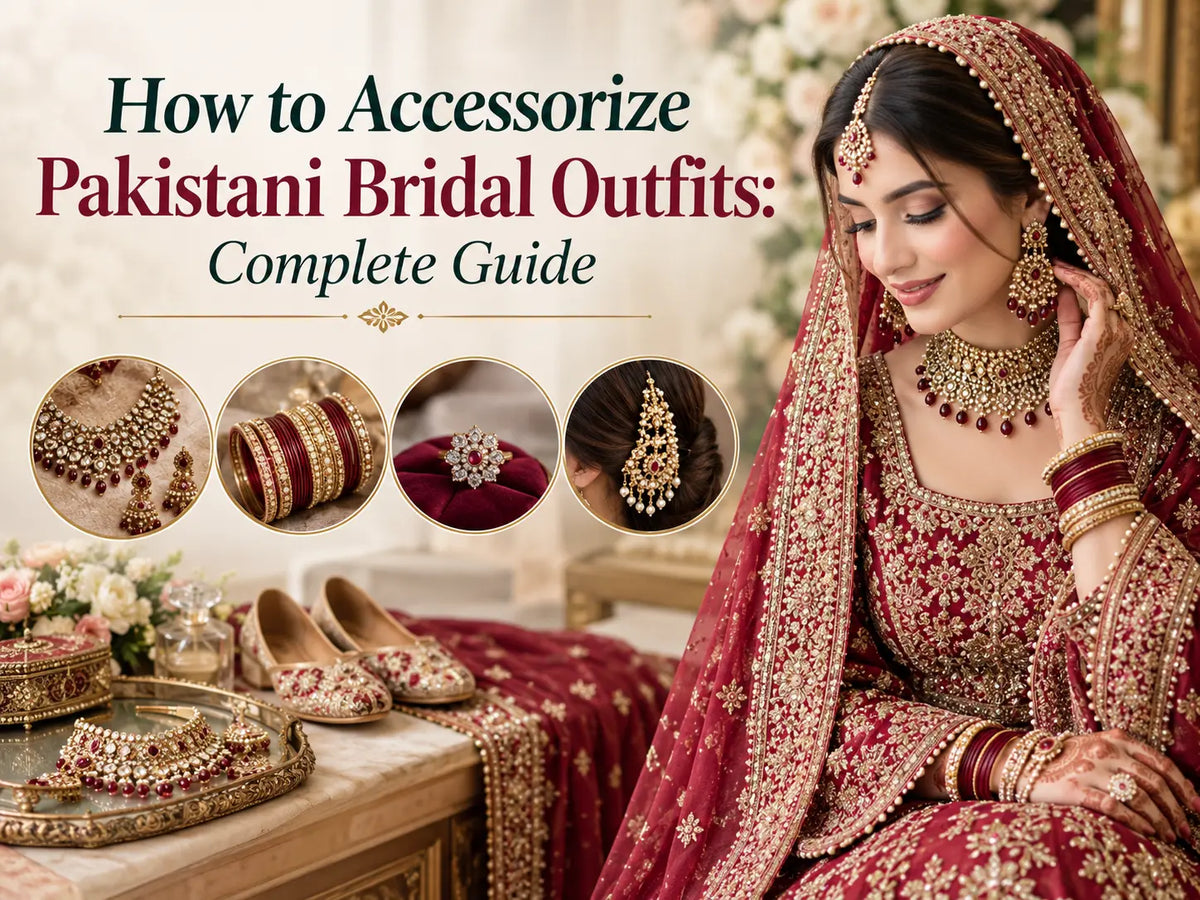
How to Accessorize Pakistani Bridal Outfits: Complete Guide
The outfit is only half of a Pakistani bridal look. The tikka, jhoomar, nath, necklace, bangles, shoes and even the dupatta pins decide whether the finished look feels balanced or crowded. Most guides show beautiful jewellery sets, but few explain how to test the full look, check fastenings, read online jewellery listings or keep heavy pieces secure through a long wedding day. This guide covers both the styling and the practical side.

Quick answers
- Golden rule? Pick one focal point, such as the necklace or the headpiece, and keep everything else supportive.
- Which metal? Gold zari suits gold-tone jewellery; silver tilla suits silver-tone pieces or white stones.
- When to buy? After the outfit, so you can test jewellery against the real neckline.
- When to trial? Hold a full jewellery trial at least two weeks before the wedding.
- On the day? Make one trusted person responsible for valuable and rented pieces.
The focal-point rule
The most common accessory mistake is wearing every statement piece at the same time. Choose one hero piece and build around it: a statement necklace with a small tikka, a dramatic headpiece with a lighter necklace, or a heavily embroidered outfit with simple jewellery. Our guide to Pakistani embroidery types explains the handwork you will be matching.
Jewellery by neckline
Always test jewellery with your actual outfit rather than the designer's campaign photo. Measure from the base of your throat to the neckline, and choose a necklace that finishes just above it, so the two do not overlap.
| Neckline | Best necklace | Pair with |
|---|---|---|
| Sweetheart or deep V | Layered necklaces or a long rani haar | Medium jhumkas |
| Round or boat neck | A choker or short collar necklace | Chandbalis |
| High or mandarin neck | No necklace, or a very fine one | Statement earrings and a headpiece |
| Off-shoulder | A broad choker | Small studs or drops |
| Heavily embroidered yoke | A slim necklace that sits above the embroidery | A lighter tikka |
Matching metals and stones
Your jewellery's metal tone should echo the metallic work in your outfit.
| Embroidery | Jewellery that suits it | Avoid |
|---|---|---|
| Gold zari, zardozi or dabka | Gold-tone, kundan or jadau jewellery | Cool silver tones |
| Silver tilla or mukesh | Silver-tone jewellery, polki-style designs or white stones | Strong yellow gold, if you want a cool, coordinated finish |
| Mixed metallic threads | Two-tone or antique gold | Bright, high-shine pieces |
| Pearl and crystal work | Pearl-drop or crystal jewellery | Heavy coloured stones |
| Colourful resham or gota | Stones picked from the embroidery colours | Too many unrelated colours |
Mixing metals works when the outfit already contains both tones, or when one metal clearly leads. Coloured stones look best when they pick up a shade from the embroidery. A quick glossary: kundan is a traditional stone-setting technique, jadau sets stones directly into the metal, and polki traditionally means uncut diamonds. Imitation stones designed to look like polki should be described as "polki-style", not genuine polki.
Accessories for each event
Customs differ between families, and some weddings combine two events in one day, so adapt these suggestions to your own schedule.
| Event | Accessory style | Key pieces |
|---|---|---|
| Mehndi | Playful and colourful | Floral jewellery, gajray, glass bangles, a paranda |
| Nikah | Soft and refined | Pearls or polki-style pieces, a delicate tikka, a light nath |
| Baraat | Full traditional bridal | Statement necklace or rani haar, tikka, jhoomar, nath, kangan |
| Walima | Elegant and lighter | Silver-tone or white-stone set with one statement piece |
If your nikah and baraat fall on the same day, start with lighter pieces and add the jhoomar and statement necklace for the baraat. Share a photo of your jewellery with the groom so his accessories, such as a kulla brooch or buttons, complement yours.
Tikka, matha patti and jhoomar
- Maang tikka: a pendant on a chain that sits at the centre of the forehead, held by a hook in the hair.
- Matha patti: a tikka with side chains that frame the face, secured with hooks at the centre and on both sides.
- Jhoomar or passa: a fan-shaped ornament worn on one side of the head, often the left, hooked and pinned into the hair.
Ask your hairstylist to set the hairstyle first, then add the headpieces and dupatta in the order you agreed at your trial.

Hairstyles and outfit silhouettes
Confirm your hairstyle before you buy headpieces. A low bun gives the best base for a tikka, matha patti and jhoomar. Side-swept waves pair well with a jhoomar on the opposite side. A braid suits mehndi and floral jewellery, while open hair needs a hidden base to anchor heavier pieces. Take your headpieces to your hair trial.
Your silhouette also changes where the eye goes. A lehenga choli shows off the collarbone, making room for a statement necklace. A gharara draws attention to the knee and hem, so embellished shoes earn their place. A short-shirt sharara highlights the hands, which suits stacked bangles and a haath phool. A pishwas works well with long earrings that add height without crowding the neckline. Browse silhouettes in our bridal wear collection.
Dupatta and jewellery placement
The way your dupatta is draped decides where each piece can sit. Use this as a starting point at your trial.
| Drape | Tikka | Jhoomar | Pins |
|---|---|---|---|
| Centre-draped over the head | Over the dupatta at the parting | Over the dupatta on one side | Crown pin, plus hidden pins above each ear |
| One-shoulder drape | Directly on the hair | Directly on the hair | A decorative shoulder pin with a hidden pin underneath |
| Double dupatta | Over the lighter head dupatta | Over the head dupatta | Crown pins for the head dupatta; shoulder or arm pins for the heavier one |
 Illustration: where the tikka, jhoomar and pins sit for three common drapes.
Accessories for hijabi brides
- Start with a grippy underscarf, then pin the hijab before adding any headpiece.
- Spread the pressure with several small pins rather than one heavy pin, and avoid pinning at the temples, which can cause headaches.
- Choose flat-backed headpieces with hooks or pins that grip fabric without dragging it.
- Protect the fabric by sliding pins in along the weave to avoid snags.
- If your ears are covered, let a statement necklace or a jewellery chain worn over the hijab take the focus.

Hands, shoes and clutches
- Bangles: mix gold kangan with glass bangles in your outfit's main colour, and put them on only once your mehndi is fully dry. Wide sleeves suit fuller stacks; fitted sleeves need fewer.
- Haath phool and rings: with a haath phool, one statement ring is enough.
- Shoes: buy them before your final fitting and wear them while the hem is pinned, so the length is right.
- Clutch: a small potli holds pins, lipstick and your phone. Ask a bridesmaid to hold it during photos.
Weight and fastening checks
Comfort depends on you and the design, so there is no universal weight limit. Check each piece before buying or renting.
| Piece | Fastening check | Support options | Snag risk | Signs of poor fit |
|---|---|---|---|---|
| Earrings | Secure backs; hooks close fully | Ear support chains (sahare) | Dupatta edges and hair | Drooping earlobes or aching after an hour |
| Necklace | Clasp closes firmly; adjustable cord or chain | A second person to fasten it | Embroidered necklines | Twisting, or riding up when you sit |
| Nath | Ring closes securely; clip-on grips without pinching | A chain hooked into the hair | Dupatta and veil edges | Pulling on the nose when you turn |
| Tikka and matha patti | Strong hooks; chains the right length | Bobby pins along the chain | Head dupatta | Sliding off-centre |
| Jhoomar | Hook holds with the full weight hanging | Extra pins along the top edge | Hair and dupatta | Tilting forward or pulling the hair |
Some imitation jewellery contains nickel, which can irritate sensitive skin. Ask the seller, and wear each piece for a few hours before the wedding to test your skin's reaction.
The bridal jewellery trial: a 15-point checklist
About two weeks before the wedding, do a full trial with your outfit, hair, makeup and shoes, ideally with your makeup artist present.
- Necklace ends above the neckline
- Necklace clasp sits flat at the back
- Earrings comfortable after an hour
- Earrings do not tangle with the dupatta
- Tikka sits centred on the forehead
- Jhoomar stays put when you turn
- You can drink and speak with the nath on
- Dupatta pins hold without pulling
- Headpieces stay stable when you bow your head
- Shoe height matches the finished hem
- Comfortable sitting for ten minutes
- Comfortable walking and on stairs
- Bangles slide over hands with mehndi
- Photographed with and without flash
- Spare backs, hooks and pins packed
Jewellery under different lighting
The same set can look very different in daylight, in a warmly lit hall and under camera flash.
| Material | Daylight | Warm indoor light | Camera flash |
|---|---|---|---|
| Gold tone | True colour | Looks richer and more yellow | Can look bright and flat |
| Pearls | Soft, natural lustre | Takes on a cream tone | Can look very white |
| Crystals and glass stones | Gentle sparkle | Warm sparkle | Strong glare spots |
| Coloured stones | Truest colour | Reds and greens deepen | Colour can wash out |
For more on how outfits and jewellery look on camera, read our guide to looking your best in Pakistani wedding photography.
Jewellery for real wedding-day moments
| Moment | What can go wrong | How to prepare |
|---|---|---|
| Sitting on stage | Long necklaces twist; heavy skirts pull the dupatta | Sit slightly forward and ask someone to straighten the dupatta |
| Greeting relatives | Hugs catch earrings and the jhoomar | Turn your head slightly to one side |
| Getting into a car | The jhoomar and dupatta catch on the door frame | Sit down first, then bring in your head and skirt |
| Eating and drinking | The nath gets in the way | Use a straw, or ask for help lifting the nath |
| Dancing | Loose bangles and earrings fall | Take off the heaviest pieces first |
| Rukhsati | Embraces and a heavy dupatta pull jewellery out of place | Have a helper walk beside you to check pins |
Accessories for UK seasons and venues
- Winter: add a matching velvet or pashmina shawl, fastened with a brooch, for warmth and good photos.
- Summer: heavy metal jewellery can feel uncomfortable, so consider lighter pearl or small kundan sets.
- Marquees and gardens: avoid long, fragile hanging pieces that can catch, and wear block heels on grass.
- Mosque nikah: keep jewellery simple, choose a dupatta that stays on your head and check the venue's dress guidance.
How to inspect jewellery before buying online
Ask the seller these questions before you pay:
- Base metal and plating: what is it made of? Is it gold-plated, gold-tone or solid gold?
- Stones: are they glass, crystal, cubic zirconia or real gemstones? Does "polki" mean genuine uncut diamonds or a polki style?
- Dimensions: how long are the necklace, earring drop and tikka chain?
- Photos: are there real product photos, not only model images?
- Returns: can earrings be returned? Many sellers refuse earring returns for hygiene reasons.
Real gold, imitation or rented?
| Option | Best for | Watch out for |
|---|---|---|
| Real gold | Heirloom pieces you will keep | Cost, security and insurance |
| Gold-plated or imitation | Statement looks for one or two events | Tarnishing and possible skin sensitivity |
| Rented | Expensive one-off bridal sets | Deposits, damage terms and return dates |
If you are buying real gold in the UK, keep three things in mind:
- Hallmarking: gold items over 1 gram generally need a hallmark. It confirms the metal's purity, not the stones. See the UK hallmarking guidance.
- Valuation: get a written valuation from a qualified valuer.
- Insurance: check whether your policy covers jewellery away from home and any single-item limits. Many insurers ask for a valuation.
Budgeting for accessories
Put more of your budget into the pieces that appear in the most photos. These shares are a starting point for non-gold accessories; adjust them to suit you.
| Category | Suggested share | Your budget |
|---|---|---|
| Baraat jewellery set | 40 to 50% | £ |
| Nikah and walima pieces | 20 to 25% | £ |
| Mehndi jewellery | 5 to 10% | £ |
| Shoes and clutches | 10 to 15% | £ |
| Bangles and rings | 5 to 10% | £ |
| Spares and contingency | About 5% | £ |
To plan accessories alongside your outfits, see our Pakistani bridal trousseau shopping guide.
Jewellery packing and handover plan
- Photograph every piece before packing
- Record rented items and their condition
- Note rental return dates and times
- Assign one trusted person to hold pieces
- Keep valuables in a lockable bag
- Never leave jewellery in a parked car
- Use a soft pouch for pieces you remove
- Pack spare backs, hooks and pins
- Carry a small pouch for loose stones; leave repairs to a jeweller
- Check everything is back after each event
Accessory mistakes to avoid
- Buying jewellery before the outfit: you need the real neckline and embroidery to choose well.
- Competing statement pieces: a big choker, wide matha patti and heavy jhoomar together look crowded.
- Skipping the trial: earrings that feel fine for ten minutes can hurt after several hours.
- Forgetting the back view: many photos are taken from the side or behind.
- No handover plan: decide in advance who looks after rented or valuable pieces.
Frequently asked questions
Can I wear a tikka, matha patti and jhoomar together?
A matha patti already includes a tikka, so pair either one with a jhoomar. Wearing all three separately usually looks crowded.
Is renting bridal jewellery a good idea?
It can be for expensive one-off sets. Read the deposit, damage and late-return terms carefully, and photograph each piece when you collect it.
Can bridal jewellery be altered to fit?
Often, yes. A jeweller can usually adjust necklace cords and chain or tikka lengths. Leave time before the wedding, and check that alterations are allowed under any rental agreement.
Is it safe to buy bridal jewellery online?
Yes, if the listing states the base metal, plating, stone type and dimensions, and the seller shows real product photos and a clear returns policy.
Do I have to wear a nath?
No. The nath is traditional but optional, and clip-on designs are available if your nose is not pierced. Test them for comfort first.
Should I buy jewellery before or after my outfit?
After. Your outfit's neckline, embroidery colours and metallic threads decide which jewellery will work.
Final verdict
Accessorising a Pakistani bridal outfit comes down to balance and planning. Choose one focal piece, match metals to your embroidery, test everything together in a full trial and decide who will look after your jewellery on the day. That way, every accessory supports your outfit instead of competing with it.
Find your bridal outfit at Kifat
Choose your outfit first, then build your accessories around it. Explore designer bridal, nikah, mehndi and walima wear from labels including Maria B, Suffuse, Faiza Saqlain, Kanwal Malik, Baroque and Afrozeh. Every order is filmed in sealed original packaging before dispatch.
Shop bridal wear Shop barat wear Shop walima wearRead next: Pakistani Bridal Trousseau Shopping Guide UK · Pakistani Wedding Photography: How to Look Best in Designer Wear · Best Pakistani Bridal Designers
Contact us
Not sure which jewellery suits your outfit? Send us a photo of your outfit's neckline and embroidery, and our team can suggest accessories that complement it. WhatsApp is the fastest way.