Article: Pakistani Designer Wear Alteration Guide UK
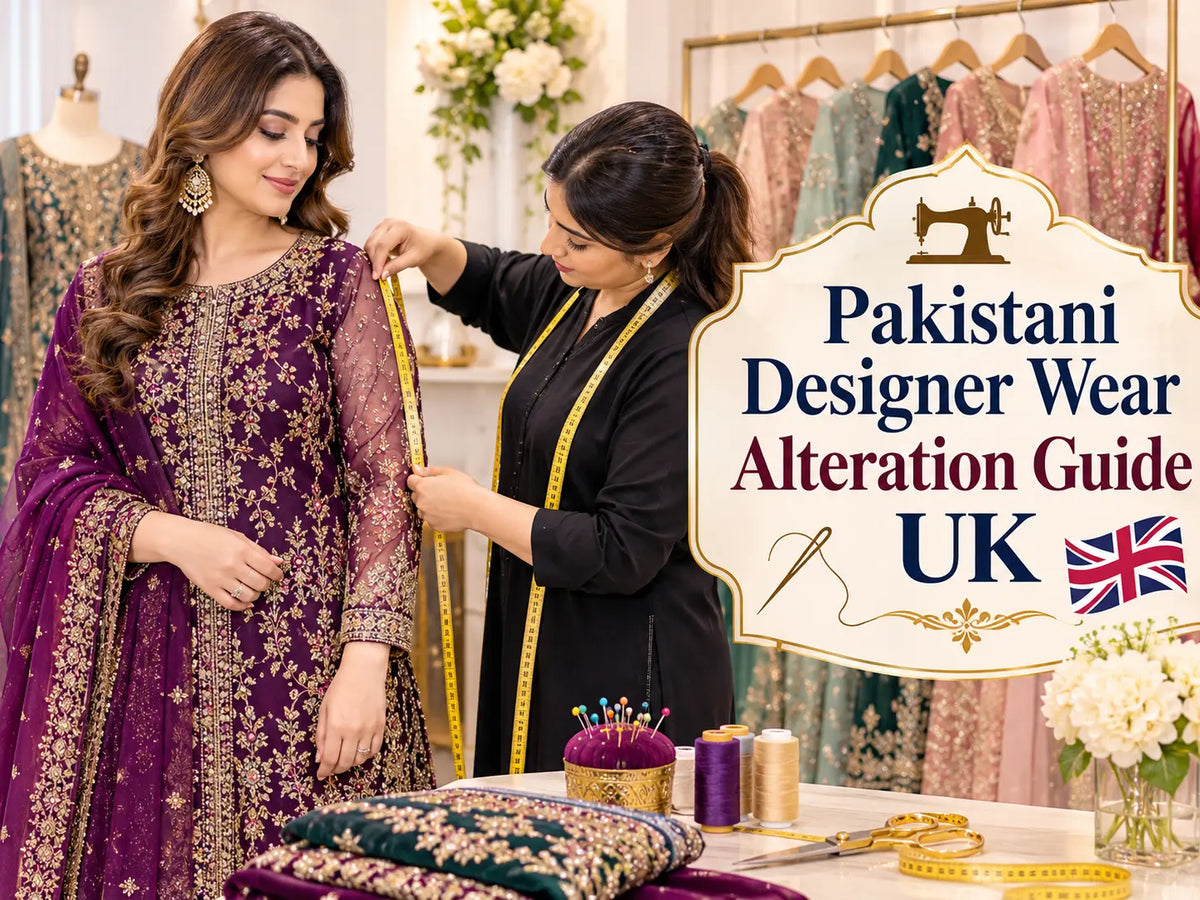
Pakistani Designer Wear Alteration Guide UK
Pakistani designer outfits can be cut differently from UK high-street clothing, and sizes vary between brands, so even a carefully selected outfit may need adjustments. Embroidery, linings, borders and delicate fabrics also make some alterations far easier than others. This guide explains what can and cannot be altered, how to fix common fit problems, how to brief a UK tailor, and how to avoid alterations altogether by getting the fit right before stitching.

Quick answers
- Easiest alterations? Shortening shirts, sleeves and trousers, and taking in plain side seams.
- Hardest alterations? Anything that cuts through embroidery, borders or embellished panels.
- Can an outfit be made larger? Only if enough seam allowance or extra fabric is available.
- Before altering a new outfit: check whether it was stitched to the measurements you supplied, and contact the seller first.
- Best way to avoid alterations: accurate measurements and customisation requests when you order.
In this guide
Before you alter anything
Try a new stitched outfit on as soon as it arrives. Under our stitching policy, alterations made by another tailor may affect return eligibility, so speak to us before making changes.
If your new outfit does not match your measurements
Before visiting a tailor, compare the garment with the measurements on your order and check the seller's measurement instructions. Then:
- take clear photographs of the garment, the measuring tape and any visible issue;
- keep your order confirmation and messages with the seller;
- contact the seller before washing, cutting, unpicking or altering the outfit, and ask what options are available.
This helps establish whether the problem relates to the supplied measurements, the garment's construction or the way it was measured.
What can be altered
How much a tailor can change depends on the cut, seam allowance and embroidery placement.
| Alteration | Difficulty | Notes |
|---|---|---|
| Shorten shirt or kameez | Usually easy | Harder if the hem has an embroidered border |
| Lengthen shirt | Limited | Depends on the hem allowance; extra fabric may not be available |
| Take in side seams | Usually easy | Simple on plain fabric; harder through embroidery |
| Let out side seams | Limited | Only as far as the seam allowance allows |
| Shorten or narrow sleeves | Usually easy | Sleeve borders may need to be moved by hand |
| Widen sleeves | Difficult | Little spare fabric in most sleeves |
| Trouser length and waist | Often straightforward | Elasticated or drawstring waists may be easier to adjust, but the lining, waistband construction and embellishments can affect the work required |
| Raise a neckline | Difficult | May need a facing or extra fabric; embroidery limits options |
| Move embroidered panels | Rarely possible | Embroidery is fixed to the fabric |
Common fit problems and how to fix them
| Problem | Likely cause | Possible fix |
|---|---|---|
| Shoulders too wide | The shoulder measurement may be too large | Take in at the shoulder seam, if embroidery allows |
| Tight armholes | Armhole or sleeve restricting movement | Ask the tailor to assess the armhole and sleeve together; they may reshape the armhole, adjust the sleeve or release a seam |
| Gaping at the bust | The bust or garment may be too loose, or the darts may be misplaced | Adjust darts or side seams |
| Tight upper arm | Sleeve too narrow | Let out the sleeve seam within the allowance |
| The shirt rides up when you sit down | Hips too tight or slits too low | Let out the hips or raise the side slits |
| Trousers too long | Length taken without shoes | Hem with your event shoes on |
| Lehenga drags | Length or heel height misjudged | Ask the tailor whether the length can be adjusted at the waistband without disturbing the border, depending on the construction |
If the outfit is too tight across the bust, hips or seat: a tailor may be able to release a tight seam if enough fabric is available inside it. However, a garment that is significantly too tight may need extra matching fabric or a more extensive redesign, which is not always possible. Ask the tailor to assess the bust, hips, seat and armholes together before work begins, rather than adjusting only the area where the tightness first appears.

Fabric and embroidery considerations
- Lawn and cotton: can be relatively straightforward to alter when the fabric is plain and in good condition; embellishments, lining and previous stitch marks can make the work more complicated.
- Chiffon and organza: delicate; old stitch lines and needle holes can show, so let-outs may leave marks.
- Velvet: needs careful handling because its pile can become crushed or marked; ask a tailor experienced with velvet to follow the care requirements and use an appropriate pressing method.
- Embroidered fabric: cutting through embroidery can loosen threads; sequins and beads may need removing and re-stitching by hand.
Choosing a UK tailor
Look for a tailor experienced with South Asian clothing such as kameez, shararas and lehengas, ask to see examples of embroidered alterations, and book early in wedding season. Complex alterations usually need at least two fittings.
What to ask before agreeing a quote
Alteration prices vary considerably with the fabric, design, location and complexity, so we have not listed fixed prices. Ask whether the quote includes:
- Unpicking embroidery
- Moving borders
- Adjusting the lining
- Replacing fastenings
- A second fitting
- Possible extra charges if a problem is found inside
Get the collection date in writing, especially before a wedding or other fixed-date event.
How to brief your tailor
Bring your event shoes, undergarments and any spare fabric or borders. Point out the embroidery that must not be cut, show a photo of the fit you want, and sit, walk and raise your arms while the garment is pinned.
 Check the fit while sitting, as you will spend much of the event seated.
Alteration timeline
- On delivery: try everything on the same day and contact the seller about any problem.
- Four to six weeks before the event: book your tailor and have the first fitting.
- Two to three weeks before: attend the final fitting with your shoes, undergarments and jewellery.
- One week before: collect the outfit and try it on once more.
Before you leave the tailor
- Try on the complete outfit with your shoes and undergarments
- Sit, walk and raise your arms
- Check the bust, hips and armholes
- Check the lining does not pull or hang below
- Inspect hems, seams, fastenings and embroidery
- Confirm the length works with your shoes
- Agree any final adjustment before collection
Altering an inherited or pre-loved outfit
Many brides wear a mother's or grandmother's bridal outfit or dupatta. Older pieces need extra care. If the fabric is brittle, the metallic thread is shedding or the embroidery is loose, ask a specialist textile or bridal-garment conservator for an assessment first, as a standard alterations tailor may not be equipped for conservation work.
Clean it first with a specialist experienced in embellished garments, keep changes reversible where possible, and allow extra time for hand repairs.
How to avoid alterations
The easiest alteration is the one you never need. Pakistani sizes vary between brands, so order by measurements rather than size labels. Our size chart and sizing guide explain how to measure.
- Measure with help, wearing the underwear you will wear on the day.
- Include the measurements most often missed: armhole, upper arm and shoulder.
- Request changes when you order, such as shirt length, sleeve length, neckline depth or slit height.
- Allow for heel height when giving trouser and lehenga lengths.
Body measurements versus garment measurements
Body measurements are taken directly around your body. Garment measurements are taken from the finished outfit and may be larger to allow ease of movement. Do not assume that a garment should match your body measurements exactly. Follow the seller's measurement guide, check whether the measurements refer to the body or the finished garment, and ask about ease before placing a custom-stitching order.
Kifat stitching and alterations
Under our stitching policy (checked on 5 November 2026; the live policy always takes precedence):
- Custom stitching is included at no extra charge, and outfits come with full inner lining and an elasticated waistband as standard.
- You can request changes to size, shirt length (within reasonable limits), sleeve length, neckline, trouser length and fit, extra lining and slit heights when you order.
- We cannot change the fabric or colour, alter the embellishment pattern or make major design changes.
- We do not currently offer alterations after delivery, and alterations by another tailor may affect return eligibility.
- Stitched outfits cannot be returned for a change of mind; we will help if an item arrives damaged, is the wrong item, or was stitched outside the measurements you supplied.
See our quality issues and refunds guide for full details.
 Collect altered outfits at least a week before the event.
Frequently asked questions
Can a Pakistani shirt be lengthened?
Only slightly, if there is enough hem allowance. Adding a matching border or facing is sometimes possible, but extra designer fabric is rarely available.
Can an embroidered neckline be altered?
It is difficult. Small adjustments may be possible, but cutting through embroidery can damage it. Request neckline changes when you order instead.
Will altering my outfit affect a return?
It can. At Kifat, alterations by another tailor may affect return eligibility, so contact us before making changes to a new outfit.
Can a lehenga be taken in at the waist?
Usually, yes, at the back seam or waistband. Letting it out is limited by the seam allowance.
Should I alter an outfit before or after buying shoes?
After buying your event shoes, because the hem length depends on heel height. Bring them to every fitting.
Final verdict
Most Pakistani designer outfits can be adjusted, but embroidery, borders and seam allowances set the limits. Check a new outfit against your measurements first, choose an experienced tailor and leave enough time. Better still, request changes when you order, so the outfit fits from the start.
Get the fit right from the start
Explore more than 28,000 outfits from over 200 Pakistani designers. Eligible orders include custom stitching at no extra charge, and UK delivery is free on orders over £100.
Shop formal wearRead next: How to Plan Pakistani Wedding in UK: 12-Month Timeline · Best Pakistani Designers for Plus Size Women UK · Pakistani Designer Embroidery Styles Explained
Contact us
Unsure about your measurements, or has an outfit arrived that does not fit? Send us your order details and photos before making any alterations, and we will help. WhatsApp is fastest.